Kindness and Integrity in Science and Business.

There is a movement, it has started and the revolution will not be televised.

Kindness is often viewed as a weakness, with sentiments such as nice guys finish last or you need to be a shark to do good business. In order to come out victorious we need to do whatever it takes to get the job done, winner takes all. These are common ideals in the media and for many years have formed a foundation of modern approaches to business.

However, these ideas assume that interactions between two parties can only ever be a zero sum game, that in order for one party to increase their share of the value another party has to lose. There are some aspects of business where this is the case, in the sale of physical products such as building materials, tools and consumables like food, market share is indivisible and cannot be held by multiple parties. But as our society has evolved to produce large amounts of digital products and knowledge based work the lines have blurred. These days value is generated through so much more than just the physical products in the world. Ways of work, digital tools that can be quickly replicated, scaled and shared and know how all form aspects of work that can generate significant value for organisations that are interacting without detracting value from one organisation to add value to another.

In 20 years of adventuring through science and business I have met people from all walks of life. One thing that I have noted is that those that have the longest and most successful careers appear to have traits in common, kindness and integrity.

See science and business are both tough enterprises. Both are careers that are full of challenges, opportunities and failures, both Science and business are founded on the idea of disrupting the status quo, science looks at the world and asks, why, how, what if? Business looks at the world and ask why not, how to and what if?

In order to succeed in either science or business an individual needs to have a strong faith in themselves and their ability to deliver results in the face of challenges and despite the fact that many others will look at them and say “you’re crazy”, “you can’t do that” or “it’ll never work”. People that foster strong connections and relationships with others in their field build a network of people to test ideas with, find solutions to new and emerging challenges and establish a trusted voice to strengthen their resolve in the face of adversity. Ultimately the measure of success in Science and Business is almost the same as in boxing, not how many times you got knocked down, but how many times you got up again. Having a strong network of friends, collaborators and even competitors can inspire us to rise up again when things look bleak.

Treating people with kindness and integrity builds trust, strengthens relationships and generates true partnerships that can generate value on an on going basis for years to come.

On the other hand, being a shark, or doing whatever it takes to finish first, burns through the people around us. People are not machines and we all remember how events have made us feel, when there is a lack of kindness or integrity we are likely to withdraw from that interaction in the future.

In the short term some people choose to take a cutthroat approach to move ahead, using people around them and burning connections to fuel their own success. This can lead to a rapid advancement of an individual, but it also leads to a lonely existence as the connections available to that individual are reduced over time. The world is an enormous place but at the same time society is small, with the rapid increase in connections through the internet and digital networks it is common for us to cross paths many times with individuals working in the same field. Over decades, individuals that chose to burn connections and relationships for their own benefit, effectively burn the bridges around themselves creating an island within their own community. This becomes a lonely existence.

In contrast, individuals that approach interactions with kindness and integrity, build, reinforce and generate new connections. This expands the reach of their network and strengthens their connections to society. So that when new challenges arise these individuals have a wide range of collaborators and connections to reach out to.

Some say that kindness is weakness, but I posit that it takes great strength of character to maintain kindness and integrity.

One of the best pieces of advice I ever received was quite simple, “When you find good people, keep working with them” this advice was also extended by one of my early mentors criteria for working with someone, they must be “a good scientist and more importantly a great human being”.

Of course there are exceptions to the rule, and in both business and science sometimes the shark can create a break that let’s them get so far ahead that they have the resources to maintain their own momentum. But in my experience the best way to build a life that you can be proud of and that will sustain you into the future is to treat everyone around you with dignity, kindness and integrity. In doing this you increase your own chances for success and those of the people around you.

The movement that has been growing over the past 10 years is the rise of Kindness.
People are no longer willing to stay in toxic work places, kindness and integrity have become key parameters for individuals assessing a new workplace and for businesses looking for partners or suppliers.

It costs us very little to be kind but over the long term that investment will continue to pay significant dividends!

So step up and test it out, be kind to those around you and see how your adventure can grow as your network gets stronger and how nice it can be to have people to catch you when you stumble on the journey.

Cheers,
Daniel
 

Posted in Life, Uncategorized | Tagged , , , | Leave a comment

A Scientists Lament

To see the world as I see it, a challenge to be sure.

This world is full of questions that need to be answered, often in the search for answers we find more questions to chase. I am filled with sadness though, at the thought that for so many young and promising researches their search is coming to an end. I started this blog in 2012, as a 26 year old, I considered myself to be a young scientist, hence the byline “The world through the eyes of a young scientist” something I should probably change as I near mid life, and yet I still feel young at heart so may keep it for a while yet. For my generation of Scientists, students that went through undergrad between 2005 and 2010, since 2015 there has been a definite shift, with the majority of our cohort finding ourselves pushed or pulled out of Academia.

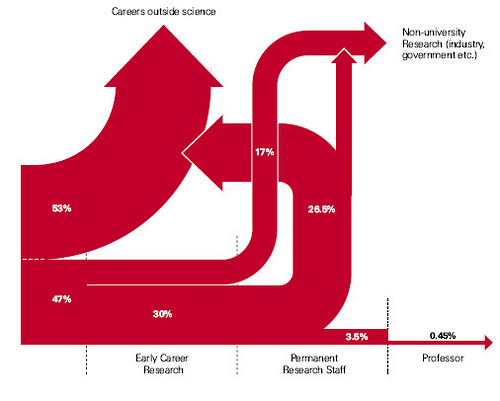
With any cohort of individuals there is always a distribution of possible outcomes, some start out not knowing what they want and finding that the path they chose is not for them, they leave early. Others are committed from the start but discover new passions and inspirations along the journey. They leave after completing undergrad. Yet others are driven by discovery and are uncertain where to go so follow the well trodden paths through undergrad to postgrad to postdoc only to discover in the end that the long term pursuit of knowledge is not what drives them. They pivot to industry or finance applying the skills of analytical thought, problem solving, resilience and tenacity honed through years of academic challenges. The final few push on and strive to make a life in academia, pushing to become professors and faculty to build a program of research that spans the years. The current reality is that over the past half a century the progress in education across the board has produced so many more graduates and doctorates than could ever be supported by the current academic system. My lament, is that for those from my cohort that wanted the academic path and pushed beyond their PhD through early careers in research so many of us (myself included) have been forced to choose paths outside of academia. A report from the UK Royal Society in 2010 suggested that of students that commence an undergraduate degree in STEM only 3.5% are able to secure long term positions in academic research and only 0.45% make it to be a Professor.

STEM undergraduate outcomes from UK Royal Society report in 2010.

In the past scientific endeavor was often the realm of the nobles, some might say that this was because they had access to better education. I feel that the because they didn’t have to worry about where their next meal was coming from their wealth enabled them. They had the freedom to think, to ask questions and to spend their time searching for answers.

In the present we pay people to do this, through research and development in private enterprise or through publicly funded research at universities or within government funded labs. However more and more this is becoming a challenge, with government funding for science continuing to be uncertain there is a growing disquiet in the halls of academia.

Most scientists I know search for a stable career, one that will allow them to tackle some of the largest current challenges for humanity, but in academia short term contracts abound with the pressure to deliver bursts of productivity and an ever increasing output of papers becoming the expectation. With most academics living contract to contract without certainty of their future state it becomes a great challenge to maintain momentum on a single problem and build to the next great discovery. Academia has broken, it has shifted from years or decades of thought to regular and predictable deliverables, with a yearly expectation on the production of new publications and outcomes. Often in academia the best case scenarios if to secure research funding for a 3 year project with defined and safe deliverables to demonstrate progress. But the challenge here is that at the end of these 3 years the funding dries up and often the researcher moves on, taking talent, skills and know how with them and leaving behind a wealth of technical capabilities that without support may fall fallow.

Our government and media often bemoans the lack of Science, Technology, Engineering and Mathematics (STEM) students  and has spent considerable efforts to encourage students into these fields. Incentives have been put in place, scholarships made available and advertising and media campaigns abound. However when you talk to young people they look at these fields and say that there are no jobs there, that the topics are too difficult. The truth is there are many jobs in STEM but we no longer have the opportunity for a true career in STEM. The opportunity for tenure, a secure position that enables deep thought and systematic development of a body of work has escaped the grasp of this current generation of Scientists and likely will not exist for those currently in training. More often these days STEM graduates are traded back and forth between industry and academia with short term contracts and career interruptions. Sometimes requiring a complete relocation from one country to another.

As a result in Australia our research institutions continue a cycle of academic consumption, with the requirement that new hires enter at the lowest funding level possible, not even being offered a position on the faculty, stay for a short period and are replaced with new hires at the entry level once they complete their grant funded activity. This serves a couple of purposes, it enables researcher mobility, ensuring that researchers are exposed to multiple academic environments and encouraging cross training. At the same time it pins academics to an entry level salary with opportunities to progress beyond being few and far between. It also results in cyclical bouts of productivity as a researcher joins an institution, builds skills, capabilities, procedures and processes to enable research to be done, then the researcher moves. Their skills are lost to the organisation, hopefully if they were lucky there was someone to pass the information on to, but this is often students in a similar position of temporary engagement and within a year or two of their departure the expertise of the lab wanes awaiting the investment of a new postdoc to bring things back to the cutting edge.

Similarly for the departing researcher, they make a move, often to a new team with a different project and different set of equipment and capabilities, effectively resetting their productivity as they need to learn a new set of tools and methods and build a new set of capabilities. The best scientists manage to maintain momentum by leveraging their past positions as collaborators in their new roles, this enables them to maintain momentum continue to support the capabilities they setup at their previous labs and carry expertise forward, however it is often a challenge to find funded projects that enable these collaborative arrangements well unless you shape them yourself.

Academia in the current climate is a tough game, and for most of us that pushed through a decade or more of postgrad and postdoc the path has run out leading us to find opportunities outside of our academic ambitions. I have great respect for those that have made it through the pipeline so far and personally I continue to strive for ongoing engagement with my friends and colleagues that remain within academic circles. As one who has reluctantly made the shift from academia to industry I still strive to collaborate whenever possible and to build bridges for commercialisation and translation of research. In saying that, I have found since my transition to industry a great freedom in knowing that my position is permanent, as long as our company is successful and I execute my role I have certainty that I will be employed. This was a game changer for how I approached my research and the scientific method as I was no longer looking for sort term gains to secure my next grant or contract.

I understand the view that tenured academics are a risky proposition as a liability for universities, some people will take advantage of job security to sit idle. But in my experience these are few and far between in the STEM field and the balance is currently too far to the short term contracts removing security from all. I feel that this has a negative impact on our research systems capability, productivity and longevity. I hope and strive to build a stronger relationship between industry and academia to enable better long term collaborations leading to new discoveries and real products that can make a difference for our society.

With that hope in mind, still I reflect and lament, that for my generation science has often become a game of politics and short term wins. I will continue to strive to build a better system that captures the benefit, builds capability and momentum in research and provides the financial and psychological safety for researchers to be inspired and push humanity to the next frontier!

Authors Note: 6 years is a long time between posts. There is a story here, one that some of my followers will know. One that I am not sure I am ready to share with the world yet. Suffice to say that a season of my life has come and passed and now I’m back so there will be more content coming to australianscientist.com.

Cheers,
Daniel

Posted in Uncategorized | Leave a comment

Science Meets Parliament 2018

Science Meets Parliament 2018 

Each year, Science and Technology Australia organises an event to raise the profile of Australian Science, Technology, Engineering and Mathematics. With an election on the horizon this year, it is more important than ever that we as scientists and researchers work to champion the research that we undertake on a day-to-day basis.

This year over 240 scientists & technologists met in Canberra over 2 days for professional development and a forum at parliament house. During the second day, delegates met privately in small groups of 3 – 5 with parliamentarians and attended a parliamentary forum with Liberal MP Karen Andrews, Labour MP Richard Marles and the Greens spokesperson for science, Adam Bandt MP.

Professional Development

This year, attendees received advice from Australia’s Chief Scientist, Alan Finkel on the importance of building relationships with parliamentarians. He encouraged us to consider Science Meets Parliament as a speed dating event that could enable long term relationships to be built with the parliamentarians that we meet. He advised us to “have rigour and integrity, be in it for the long haul, know communication is key, and keep up the maintenance and renovations” on our relationships with parliamentarians beyond the meeting in February.

The CSIRO CEO, Dr. Larry Marshall supported Dr. Finkel’s advice by suggesting that we play the long game “It isn’t about your agenda, it isn’t about your science — it’s about the national agenda to solve a national challenge.” The Scientific community is often poor at advocating for itself and research funding is unfortunately seen as a viable target for budget cuts when the economy is in decline. Part of our roles as researchers in Australia is to develop and promote solid research programs that actively work to solve real world problems and make life better. Larry said it well when he described why so many of us enter into science “We have a diversity of people here in the room, all united by a common passion: to make life better.” In order for us to be able to do the work we love and continue to explore how life works, we need to raise our voices to be heard collectively. In the public sphere, the political sphere and in our private spheres, as the public’s perception of the importance of science has an influence on the actions of our policy makers.

A final point from the public comments of parliamentarians that I would like to highlight, is that the leader of the opposition Bill Shorten MP committed to pushing for an increase in the science budget allocation from 1.8% to 3% of GDP if Labour is elected. The Greens have responded with a promise of 4% and the Liberals have promised to keep delivering their innovation agenda. These are of course only promises but it is rare for the leader of the opposition to make such bold statements in a public forum and reiterate them through their spokesperson. It is a promising sign for the future of science in Australia, one for which I continue to hold onto hope that we may one day see.

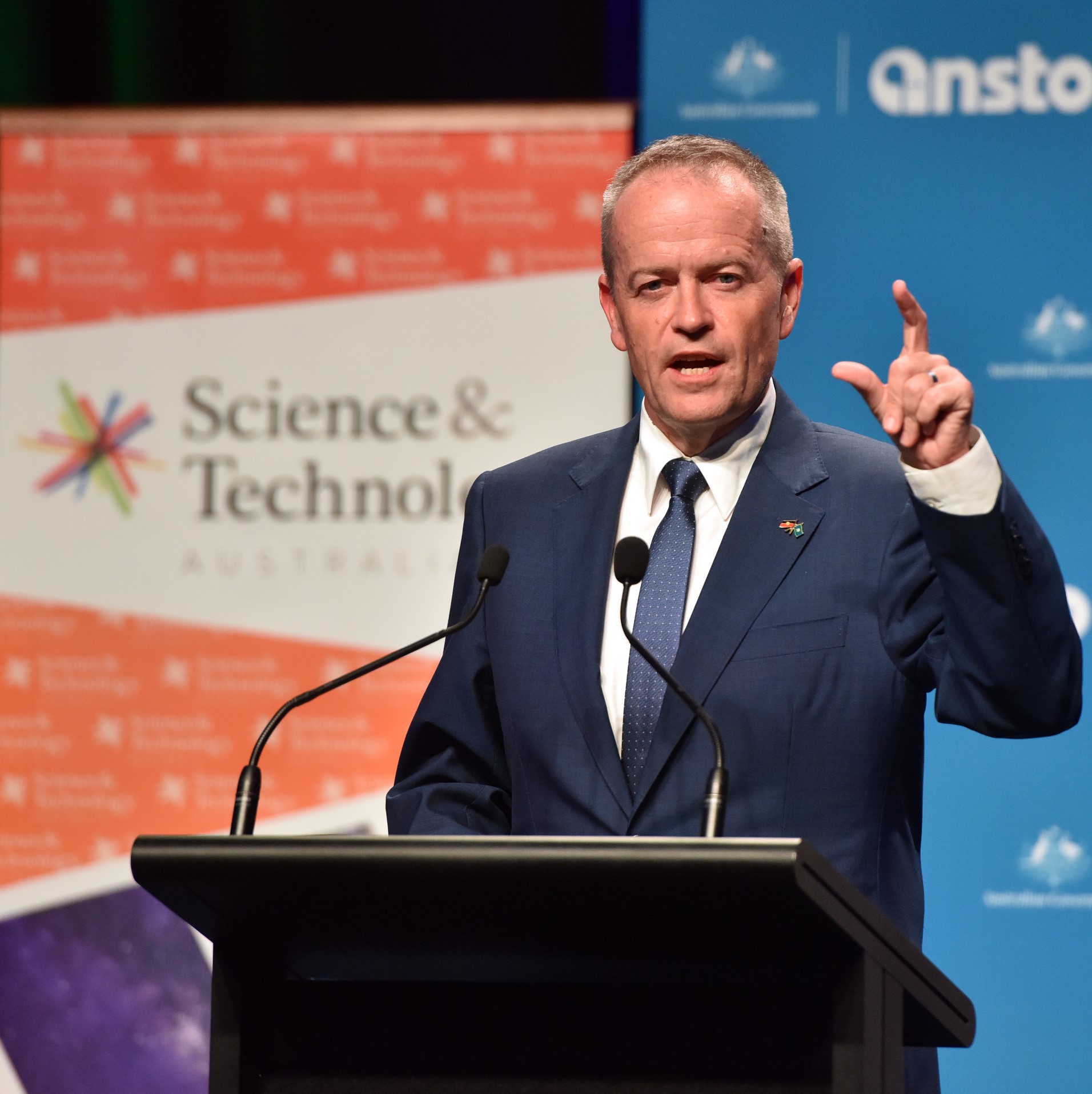
Shorten declares 3% GDP funding for Science if Labour is elected at next election.

Opposition leader Bill Shorten at Science Meets Parliament gala dinner in the great hall, Parliament House, Canberra on 13th February, 2018. PHOTO: MARK GRAHAM


Defining the agenda

After deliberating with the ASBTE President Dr. Helmut Thissen, my mission as a representative for ASBTE was to raise two simple issues, which have a huge impact on the way that we do research. These issues were:

  1. Multidisciplinary research lacks a dedicated funding source.
  2. Mental health of researchers/academics and students is not managed well.

Interestingly, one of the first comments that Science and Technology Australia President Professor Emma Johnston made was that, “when meeting parliamentarians one should never ask for more money, as parliamentarians hear this all the time and it’s the best way to make sure you lose their attention.” This point was re-iterated several times throughout the professional development sessions. A second point that was well covered was that when meeting parliamentarians we need to remember that they have a lot on their plates, so keeping your ideas concise and direct is essential and presenting problems with potential solutions rather than problems alone is vital.

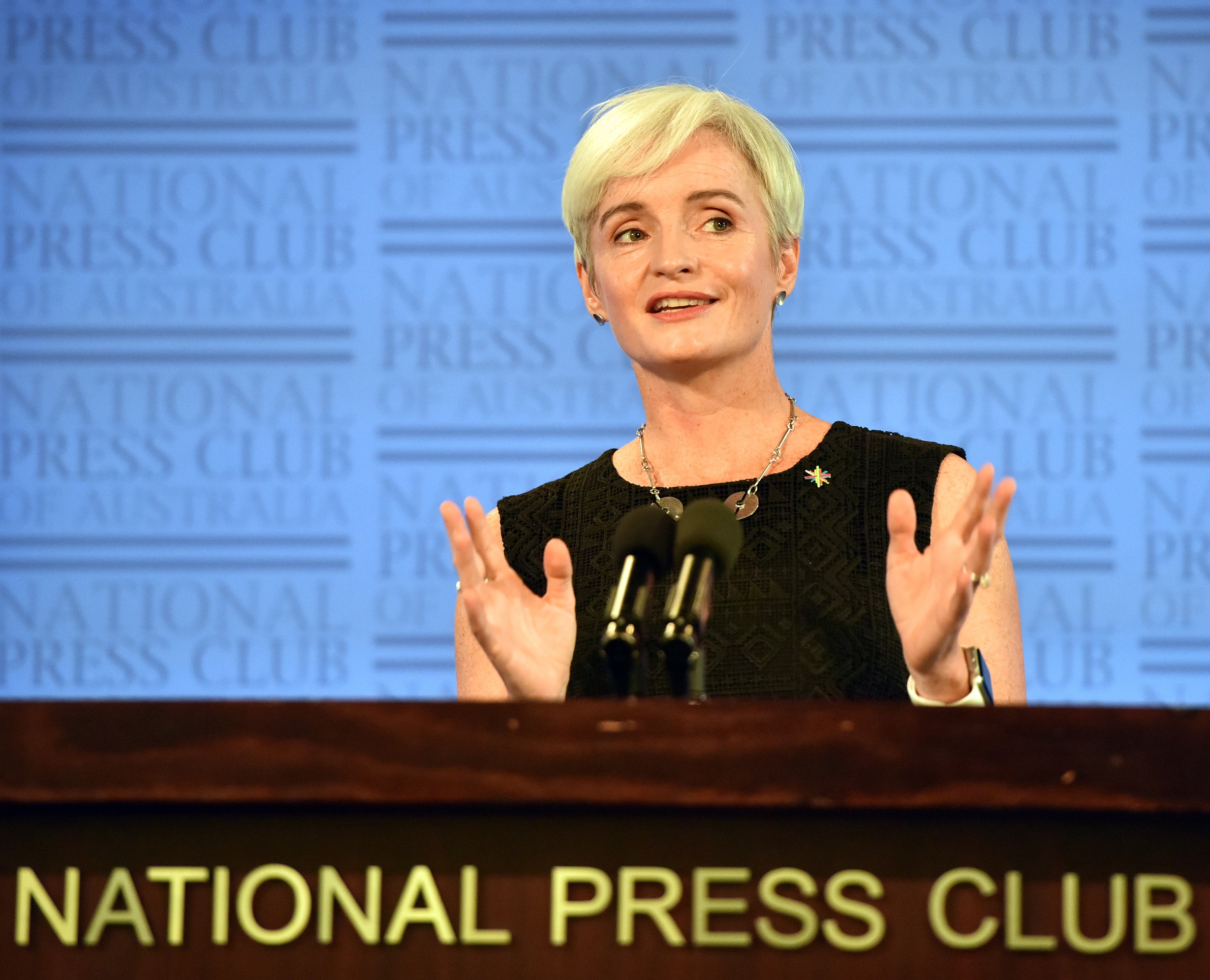
Emma calls for an end to short termism

Science Technology Australia President Professor Emma Johnston speaking at a National Press Club event, Canberra on 14th February, 2018. PHOTO: MARK GRAHAM

Prof. Emma Johnston giving her national press club address. Science meets Parliament 2018: Photo by Mark Graham

With these suggestions in mind, I gathered with the other delegates (researchers, students and technologists), in order to discuss how to approach our meetings with the parliamentarians. In some ways, these preparatory meetings were as important as the meeting with the parliamentarians. They allowed people from diverse backgrounds from all over Australia to meet and discuss what is important for science going forward. I was extremely pleased to find that the two issues that we wanted to raise were universally accepted and recognised by the other delegates. However, it was saddening to hear the responses to mental health issues in science as each delegate I spoke with told their personal tales of burnout, depression, mental breakdowns, bullying and harassment. This is a topic that has been taboo for too long in society in general and particularly in science as mental illness is a disease which affects our most precious tool, the mind. Having recently experienced my own challenges with mental health and losing a long-time friend and colleague Dr. Brad Stringer to his battle with the black dog (depression), I am determined to speak out about this issue.

The solutions that we proposed to address these two issues were:

  1. Multidisciplinary research: In the current funding environment dominated by the ARC and NHMRC, interdisciplinary research often falls through the gaps. The fundamental and applied interdisciplinary research needed to develop the tools and equipment to enable medical research is often rejected, as grant applications to the NHMRC are deemed to be too fundamental and grant applications to ARC are deemed to be medical research. The stated mandates of the ARC and NHMRC allow for the exclusion of research based on these criteria and although this distinction is designed to facilitate the grant assessment process and clarify which funding body researchers should apply for, the success of grant applications that cross multidisciplinary boundaries suffers as a result. We pushed for parliamentarians to legislate that proposals considered by the NHMRC or ARC to be more appropriate to the other funding agency should be considered by a panel from both. By allocating a small portion of existing ARC and NHMRC funding to projects that cross the boundaries between fundamental and medical research we can support important work that is currently underfunded.
  2. Mental health management: Currently, the largest challenge that researchers and students face within academia and research is a lack of certainty. With the on-going trend of short term contracts and a severe lack of clear career progression pathways, Australia’s best and brightest are being undermined by their fears for the future. Additionally, pressure from funding bodies and employers alike is driving the development of unhealthy work practices and overstretched employees. Finally, the combative nature of science and the fact that we are working at the forefront of knowledge means that often researchers experience long periods of ‘failures’, where each experiment teaches us something but may not produce a publishable result. Though science progresses through experimentation and knowledge grows with experience, the pressure to publish or perish can be hard to stand up against after extended periods where nothing seems to work. Although this is part of the process of discovery, it is easy to feel disheartened when hundreds of hours of careful thought, experimental design and execution does not result in something publishable. Unfortunately these experiences currently pervade the higher education and research sectors globally with recent studies suggesting as much as 75% of academics, researchers and students experience severe mental illness, which is three times the occurrence in the Australian general public. As a solution to this endemic challenge we proposed that government should look at moving beyond the short termism of current funding practices, allowing researchers to be employed on long term contracts within universities but reallocated to different projects as strategic directions shift. This is not a final solution, nor is it one that is easily implemented, but Emma Johnston’s national press club address, (certainly worth reading if you missed it https://tinyurl.com/smp2018NPA) called for a similar shift in perspective, if not for the same reasons.


Meeting the Parliamentarians:

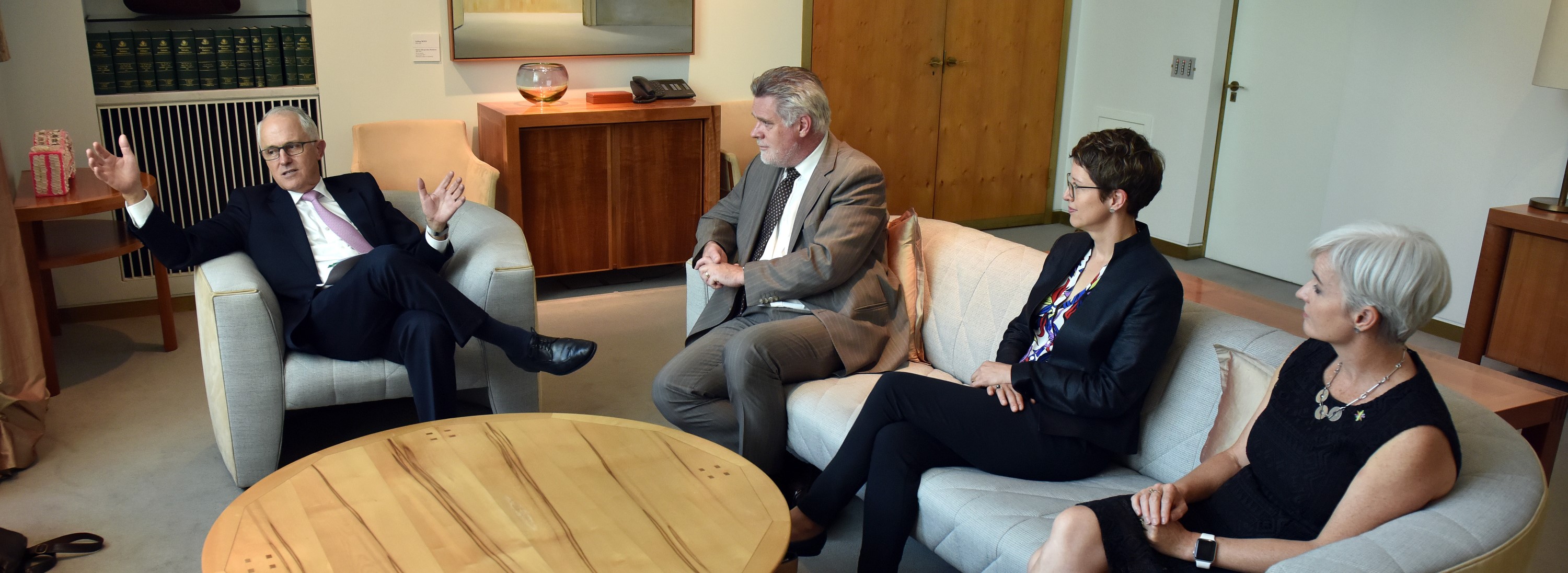
“Science Meets Parliament” conference attendees meet with Prime Minister Malcolm Turnbull in his office at Parliament House, Canberra on 14th February, 2018. PHOTO: MARK GRAHAM

I was invited to attend two meetings with Labour MP’s Madeline King and Maria Vamvakinou, respectively, these meetings went very well and have resulted in an invitation from Maria Vamvakinou to come and discuss these topics when she is back in Melbourne. Throughout the event all the parliamentarians I was able to speak with personally gave me the impression that they do care about science but need a reason to voice a desire for change. I urge each of you to reach out to your local MP and raise the issues of interdisciplinary funding and mental health with them. These issues deeply impact the ability of the Australian science community to undertake the work they do. Their impact is twofold, one affecting the purse strings and the other an insidious and often silent or hidden burden that our friends, colleagues and we ourselves too often bear alone.

Cheers,
Daniel

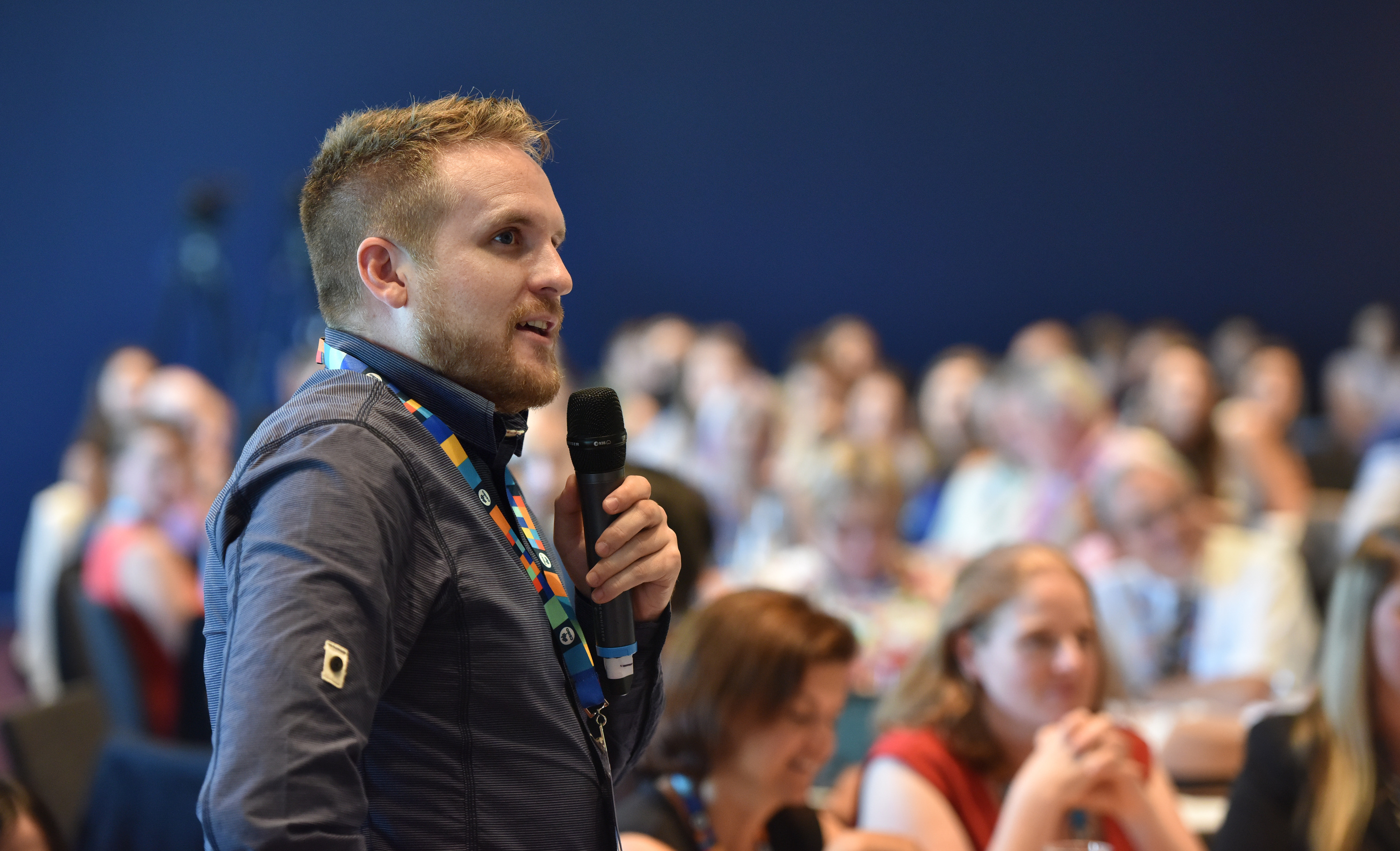
Dr Daniel Langley representing ASBTE at SMP 2018

Dr Daniel Langley representing ASBTE at 2018 Science Meets Parliament conference at the National Gallery of Australia, Canberra on 13th February. PHOTO: MARK GRAHAM

Posted in #AusPol, Education, Science | Leave a comment

Single Particle Imaging: Finding out the structure of life’s building blocks

So it has been a week since I left Melbourne and I have participated in something that has changed my perspective of the world. It is a rare opportunity to stop and appreciate moments like these, where you can feel from one moment to the next a shift in the way you think about the world.

I have the rare pleasure of doing what I love for work, Science! As part of my role at the ARC centre of excellence for advanced molecular imaging I have had the opportunity to be involved in an extremely exciting project. This project is called the Single Particle Imaging initiative (SPI for short) and involves trying to push the boundaries of conventional diffraction to achieve atomic resolution from single particles. While the ultimate aim of the project is the ambitious goal of trying to capture movies of molecular interactions such as the binding of drugs to virus particles, we are still a long way from achieving this. As with most things the journey of discovery starts at the beginning with small steps.

So far the SPI has been able to achieve some incredible results and in this past week we were able to demonstrate that it is possible to deliver single virus cells (28 nm MS2) into an x-ray beam that is less than a quarter of the diameter of a human hair. We also demonstrated that we can get useful data from such a particle and hopefully we will be able to use that data to reconstruct the external shape of the particle. This technique is revolutionary because it uses individual particles instead of the crystals typically required to achieve atomic resolution. Although we are not there yet, if this data proves to be what we expect from it, we will be able to demonstrate that we are working on the foundations of a technique which may forever change the way we look at structural biology. It is a lofty goal and is certainly a challenge yet it is one that inspires me contribute and learn from the large global collaborative team.

These experiments are the result of work by over 100 researchers from over 20 different institutions around the globe and at this particular beamtime (an allocation time to use a powerful x-ray source to perform an experiment) we brought together 20 people from 6 nations to work together to push the frontiers of science.

You can find a copy of my video summaries and an interview I did with beamline scientist Andrew Aquila (One of the people that maintains and runs the x-ray source and leader of SPI). There will be more videos to come in the next few days which you will be able to find at the videos summaries page so please keep an eye out for them.

Cheers,
Daniel

Posted in Uncategorized | Leave a comment

The curse of mental work

In the information age, modern technology eases the physical tasks that we require to produce food and shelter but introduces a new form of labour that places its own burdens on our society.

It is an interesting thing that has happened in the western world in the past century and is continuing to occur in Asia and the developing world. In the past century the majority of people have moved from the country to large metropolitan centres. The number of people and the amount of labour required to produce a given amount of food has continued to fall and so people are inventing new ways of working. With the introduction of computers into our society increasingly tasks are becoming knowledge based, there are of course two sides to this trend. People are able to access more information and learn more skills than previous generations, however at the same time we are starting to lose track of where to place value.

As society progresses into a truly knowledge based economy we will increasingly find that the lines between home and work will blur. The problem lies in human nature and the growing complexity of our employment networks. With mobile phones providing constant communication lines (often including emails now) it becomes more challenging to actually switch off and disconnect from your daily tasks. This is especially true for those that work on large scale projects with multiple challenging components within them. We like to solve our problems and finding the balance between thinking about the problem at hand or contemplating the larger challenges in our work lives is often difficult to do.

I am lucky enough to do something that I love, I have the opportunity to study the way the world is put together, to develop new devices and techniques to grow our understanding of the world and of ourselves. The centre in which I work has some big goals, we are striving to develop new ways to identify and image the structure of proteins, viruses, cells, material stress and strain. It is a challenging goal with many projects contributing together to build towards the long term goals. It is a great opportunity for me to be a part of such a talented team of people from all over Australia and to collaborate with world leaders on a project which could possibly have such broad implications.

However it has its down side, my work is in my head and I carry it with me wherever I go. Often in the quite moments of everyday life my mind turns back to the challenges of my job. The project that we are working on occupies my thoughts with no regard to the time of day or the situation I am in.  Sometimes it keeps me awake at night and often it intrudes on my weekends, the lines between work and life for me are quite ill defined. The exceptions to this would be the time I spend with my wife and in nature, few things can distract a person from their work more than appreciating the wonders of the world or the company of the person they love.

I don’t think that I am alone in this, it seems to me that as we move to mental work it becomes more difficult to leave the job in the office. I recognise that there needs to be a balance, often we talk about a work/life balance, it is often sought but seldom found. In reality though this is a necessity in order to be effective in your job, especially in a knowledge based job. Finding this balance will give you strength, space to think and creativity.

If you have some tips for how to get it right I would love to hear them, for now I continue to strive for a way to separate my mind from my work when I am not there and to immerse myself fully when I am.

Cheers,
Daniel

Posted in Life, Science | 2 Comments

The smartest person in the room

I heard an interesting comment the other day:

“The smartest person in the room is not the one that knows the most, but the one that can ask the most interesting question”

Dr. Jeanette Fyffe

The view that we take on intelligence is formed by our experiences and by our perception of the world around us. In many ways the education system on which we build our society trains us to perceive that the smartest people are the ones that have all the answers. This idea is further enhanced by our media through TV shoes like Jeopardy, The Eggheads and QI to name a few. However in the years I have spent studying and expanding my knowledge I have found that learning something new often raises more questions than answers.

It is an interesting perspective to look back on the road I have traveled and try to pinpoint the time that I recognised what Jeanette put so eloquently into words. That as we learn and equip ourselves with knowledge true intelligence shows itself by connecting the dots and probing for more. I have known it for a while now, at least on some level I may have always known it, I have always been asking questions, (though not always the most interesting ones). To pin down the time that I recognised it consciously I would probably assign it to interactions with my masters supervisor and a German professor at La Trobe University in 2010-2011. Watching them as they approached a problem and interacted with students and other researches I learnt that often the trick to learning something about the world is to ask of it the right questions, and keep working till you find some answers.

It is a challenging thing to instill in someone the idea that they do not have to have the correct answer to be seen as intelligent, for so long students struggle to differentiate themselves from the pack by knowing more. Working now on the other side of the university system I can see that some students still want to have the correct answers all the time. When you get to a postgraduate level and are working in science to have all the answers is a waste of time… To do something unknown and to stretch the boundaries of human knowledge that is where the rewards lie.

I want to help students to become researchers, where the primary challenge is to put what you know into practice by trying to solve a problem or answer a question, but first you have to come up with that question. Teaching students to look at a project and ask what do we need to make that a reality and to troubleshoot their solutions when they don’t work is probably one of the most important skills that we can impart. It is not the failure or success that is important but like so many things in life, the journey.

I don’t know how to do it yet, but I am thinking carefully and asking myself how to be a good supervisor, to encourage and develop the people that I work with into independent thinkers. This is a journey that I myself am taking but thankfully I have some great people to bounce my ideas off and to help me find the right questions to ask.

Cheers,
Daniel

Posted in Education, Science | Tagged , , , , , | 2 Comments

Forge

The past year of my life has been the hardest so far.

I don’t expect that it will be the hardest of my whole life and in a way I really hope that it isn’t. I have learnt a lot about myself and my view of the world in the past year and I have realised something intrinsic to the nature of life. The path we take through the years is a journey of space and time, and each step that we take defines who we will be in the future.

Throughout our lives there is a process of construction that is ongoing and integral to who we are and what we become. Similar to the growth of a forest and the forging of tools by a blacksmith our identity and skill sets take time to develop, go through times of growth and expansion, get cut down, beaten, placed in the forge fires and dowsed with water. In tough times our life and the identity we have built around ourselves is put to the test, a trial by fire that burns away the weaknesses and leaves behind only that which could withstand. It is the hard times in our lives that define us that show us what our core is made of and what we are truly capable of. Sometimes we don’t stand the test, sometimes we collapse and come through the fire with nothing left. Other times we are burnt back to a foundation of strength, reminded of what is important and pushed to stretch ourselves to a new challenge.

I hope that this year is not the hardest year of my life as I know that in the tough times I grow and change, in the tough times I become a better version of myself or I lose the bad parts that I have started to incorporate. The challenges of life remind us of what is important and push us to cast aside the pretenses that we use to shield ourselves from the outside world.

I am a scientist, of heart and mind. One of the things that brings me joy is to discover something new, to talk to other scientists about their research and make connections between disparate ideas and fields. I can talk for hours about the nature of light, the movement of electrons and the interactions of elements, but at the heart of this is a quest for understanding. How does it all work and how can we keep on moving forward? I want to use the gifts that I have to help improve the world, to work on problems of energy and environmental balance. For some years I have dreamed of being a famous scientist, but I realise now that this dream is unimportant. I don’t think Edison, or Tesla, or Einstein sat down and planned out their 10 step plan to becoming world famous scientists. What is important is to love what I am doing and simply to focus on being the best that I can be.

My father gave some words of wisdom last night, he said to me “just do it the way you eat an elephant… little bits at a time.” So many expressions center around this idea, that good things are comprised of many small steps taken over time. That is the way that I want to live my life, moving forward one step at a time, I know that sometimes I have to go through the fire but hopefully that makes me stronger. Most importantly I know that if I ever come to the fire that burns me down I have friends and family that will help me to rebuild.

Take some time out this week to think about the hard times in your life that made you stronger, and when some of those times got too hard remember the people that helped you pick up the pieces afterwards these people are worth more than I can express.

I am going to keep on moving and remember this fire as one that brought me low, but reminded me of who I am and what I want to be. Just taking it little bits at a time and moving toward being the best version of myself.

Cheers,
Daniel

Posted in Life | 1 Comment

Sacrifice

Sacrifice, are all things in life dependent on the sacrifices we make to earn them.

Long ago most people believed that by sacrificing things to the gods, or a God, things could be gained. Some people still believe this, and those that don’t should.

We all have our own gods and make sacrifices to them. If money is your god then you sacrifice time and energy and possibly family and friends in order to get more.  People obsessed with food sacrifice time and money and often their own bodies on the altar of fine cuisine, fitness freaks sacrifice fine foods and sleep to make that effort to get up at five in the morning and go for that run or ride. By sacrificing in this way people get what they desire but in the end are often pulled into being slaves to the object of their worship.

At the moment I am learning a lot about the meaning of the word sacrifice, as with all things there are different levels of commitment, I chose to commit to the vision that I have, I see a world that is broken and I know that we as a race can do better than we are currently doing in looking after our planet and each other! I stepped out trusting in the gifts that I have been given, in the education I have received, in the life skills that my parents and friends have taught me. In the mind that I was born with and the personality that has grown within me in the past 27 years.

I stepped out, of my comfort zone, of my home, my country and my life. I laid it all aside and began to build anew, it has been a long road so far and it has truly been a sacrifice, I have had to make tough decisions along the way and to give up things that I never expected to lose. Since this time 2 years ago, I have moved from Melbourne Australia, 16,000+ km to Belgium, then another 800 km four months later to the French alpes. I have spent 12 months living on a separate continent to my wife, missed the birth of many of my friends first children. Heard of family and friends suffering through illness and loss, but been unable to be there in person for them. I have been alone, completely and utterly alone in a land where I didn’t speak the language for weeks at a time.

But I wouldn’t change a thing!

I have grown and learnt so much in the past year and a half. Things about myself, things about the world, other cultures and universal truths. It doesn’t matter where I go it is possible to find good people, in fact not just good people but excellent people! I have met people in the 2 years from almost every continent on earth, from many different cultures, backgrounds, race and religious orientation and I have forged friendships that will last a lifetime! The more people I meet the more I realise that on many levels we are all the same. 

We all make sacrifices, and we must, for as Theodore Roosevelt said “Nothing in the world is worth having or worth doing unless it means effort, pain, difficulty… I have never in my life envied a human being who led an easy life. I have envied a great many people who led difficult lives and led them well.”

Good things come at a price and the sacrifices required to attain something is often proportional to the value of the reward. As I mentioned in a previous post we are the sum of it all, and every step we make builds us into the person we are. So let me challenge you to think about the sacrifices that you are making in your life, are the objects or goals you are trying to obtain worthy of the price you are paying?

As we move forward, many people seem to believe that humanity is moving away from the need to worship a deity, I think that mostly people still worship but they put their faith in science, money, sports people and musicians. They trust in these things, take joy and support from them. It is still relying on something outside ourselves but more and more it seems to shift away from the supernatural and into the human world. As a scientist with a belief in God, I stand in an interesting position. Some people would say that my view point is contradictory to itself, a paradox that should not be accepted. I disagree but that is not the point in the end, the point is that we should accept the views of those around us and though we may disagree with them we should not try to force anyone to change their view just to join ours. We should encourage every one to question everything, ourselves included. For blind faith is not a thing to be treasured but is a thing of fools, for people blindly following without questioning is where the world falls apart.

I see a world that is broken, but I know that there are good people in it and if we can put aside our differences and work together I think that the future could be a bright place! I am very grateful for the experience that I have had in the past 2 years. I look forward to the things I will learn in the coming months and years, but more importantly I look forward to the people I will meet and the friendships that will grow. I know that the choices I make lead me down the path I walk and I believe that the sacrifices I make are worth the price I pay.

Thanks to those that know me for the contributions you have made along the way, to the man that I am and the man that I may become, I hope that in some ways I can return the favour and plant in you some seeds that may help to make the world a better place.

Cheers,
Daniel

Posted in Life | Tagged , , , , , | Leave a comment

The Mad Scientist

“The poet only asks to get his head into the heavens. It is the logician who seeks to get the heavens into his head. And it is his head that splits.” – G. K. Chesterton

There is a truth that most people I know recognise, to be a good scientist you have to be a little bit crazy. I don’t mean crazy in the sense that you have entirely lost touch with reality but crazy nonetheless. To some extent scientists lose touch with the normality of the world and begin to see it from a different point of view. Taking great joy in the simplest things and trying to understand the question, why?

It is easy in life to except things as they are but the scientist has to know why! In many cases people would say that seeing something that nobody else around you can see is a sign of madness, but scientists train themselves to see patterns and relationships in the world, they search for answers to the questions that most people don’t even see. Driven by the excitement of finding something new, of describing how the world works or a tiny part of it at least. This is where the crazy comes into the equation, somebody choosing to spend a lifetime working on something so small it can never be observed by the naked eye, something so insignificant that we can never touch, hear or feel it occurring. It seems mad, to think that this thing that normally goes unnoticed could be worth spending a life exploring. Yet take the motion of atoms in a liquid as an example it is happening all around us all the time and even inside us, understanding it could contribute to medicine, energy and environmental projects. Yet most of us are unaware of it happening.

Scientists don’t always know what their work will lead to but as each one contributes their piece to the puzzle the human race moves closer to understanding the bigger picture.

It takes someone crazy to see what is really there, to put the pieces of information bombarding us daily into order and see the bigger picture. To work all night, forget to eat, find inspiration at the bottom of the sea or in the emptiness of space. To question an insect or to spend hundreds of hours making computer models of falling sticks. Scientists need to be persistent, observant and slightly obsessed. If you are lucky enough to know a scientist you will probably agree that they love their work, and in the end this is often all the proof we need to recognise that they are slightly crazy.

Loving something that rarely works, few people in the world actually care about and often results in going round in circles is a strange idea. In the end though it is the sum of these works that have brought humanity to where we are today, the obsessions of a few support and enable the discoveries needed to improve the lives of many.

“There is no great genius without a mixture of madness.” – Aristotle

No man can get the entire heavens into his head but to hold the equations that describe them in your mind is possible. Have patience if you know a scientist and recognise that their small idiosyncrasies are a sign of the genius within.

Cheers,
Daniel

Posted in Science, Uncategorized | Tagged , , , , | 1 Comment

Activation Energy

There is a certain beauty in the daily struggle we have to do regular things.

We all struggle to do something. It doesn’t matter who you are or how well you can do most things there is always something that is harder for you than it seems for most people. For me at this time in my life it is most definitely language. I am really struggling to put the pieces of French that I know together in my head, wrap my tongue around the words and spit them out in a way that is comprehensible to a native French speaker. Its a little funny that I have to make that distinction, but for most people I speak to, the foreigner understands my French and the local doesn’t. I think its about accent and the expectations of the individual, the non native speakers recognise the sounds I am trying to make from their language, and often make the same ones as me when trying to imitate certain French words. For us it seems so simple to connect the sound I am making to the French word. For the native speakers it is more difficult, they know exactly how the word should sound and aren’t expecting to hear much else, this can be quite tough at times.

All tasks that we undertake require energy, and so often the energy required at the beginning of the task is the majority of the energy required for the task. Once you get past that first little bit the rest follows naturally and easily. It is the activation energy of a task that can prevent us from beginning the task in the first place. However, activation energy is a funny thing, sometimes it drives us to do other tasks instead.

I recently had a project from work that was time critical and labour intensive. These two things combine to make a perfect storm that many people have experienced but may not have been aware of at the time. The uni students and scientists among you will definitely be aware of this phenomena. As the deadline draws near you go through several phases, the driving force that says you should get started on the task begins to build. As it grows we reach a point where we can’t avoid the reality that we should be working on that big project. At this point there are two options really, the good choice is to start working on the project. The option most people chose however, is procrastination. Delaying the task as long as possible. There are two types of procrastination and which kind we move into I feel is dependant on how important the task at hand is.

When the task that is providing this driving force is not particularly important we get the first kind of procrastination. The unproductive kind, it leads to things like “I should be doing #### but I’ll just check my emails…” this can go on for hours. The second kind of procrastination occurs when the task you are avoiding is important. The thought process goes something like this… “I should be doing ####, it’s really important. So if I am not doing #### I should have a good reason…” This type of thinking leads to productive procrastination. We fill our lives with productive minor tasks that all have a lower activation energy than the major task we are avoiding. These minor tasks are still important thing that need to be done and by completing them we can justify to ourselves not starting the major task because we are getting things that needed to be done finished.

Now this is all a game that is played out across the globe daily, we balance the check books inside our heads telling ourselves that we are coming out on top. So the question is how to use this information, when you recognise that the unproductive procrastination is not your friend you can watch out for the signs and turn your productivity on its head. The key to success in this is breaking the task down into smaller easily achievable tasks.

Instead of looking at learning French as a whole I am starting to break it down, into small tasks or challenges that I need to tackle. Learning fifteen new words a day on memrise greeting my boss in French, taking another course or calling a plumber. Small tasks have lower activation energy and don’t seem as daunting. This means that I can start them and run through from one task to the next.

Setting these kind of goals can allow you to build all kind of things. The more I do it the more I find that the key to working productively is to break the tasks down and finish each one as you go along, its a simple secret. One we all should know but I think sometimes it gets lost when we try to focus on the big picture.

In the end balancing big picture foresight and jigsaw puzzle task management (one piece at a time) is the best way to be productive in the long term. So take a step back today, see what the big picture task you are trying to achieve is and try to break it down into bite size pieces, you will be surprised how much faster you can get it done.

Cheers,
Daniel

Posted in Genial - It's french for awesome, Language, Life | Tagged , , , | Leave a comment