To see the world as I see it, a challenge to be sure.
This world is full of questions that need to be answered, often in the search for answers we find more questions to chase. I am filled with sadness though, at the thought that for so many young and promising researches their search is coming to an end. I started this blog in 2012, as a 26 year old, I considered myself to be a young scientist, hence the byline “The world through the eyes of a young scientist” something I should probably change as I near mid life, and yet I still feel young at heart so may keep it for a while yet. For my generation of Scientists, students that went through undergrad between 2005 and 2010, since 2015 there has been a definite shift, with the majority of our cohort finding ourselves pushed or pulled out of Academia.
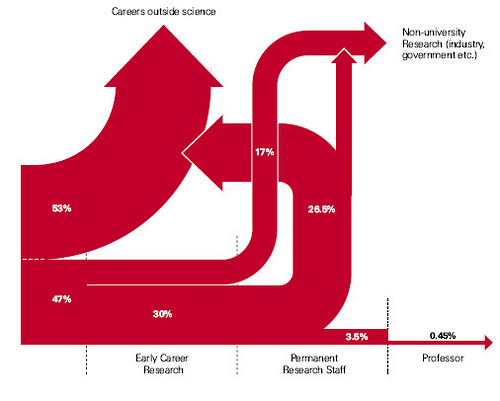
With any cohort of individuals there is always a distribution of possible outcomes, some start out not knowing what they want and finding that the path they chose is not for them, they leave early. Others are committed from the start but discover new passions and inspirations along the journey. They leave after completing undergrad. Yet others are driven by discovery and are uncertain where to go so follow the well trodden paths through undergrad to postgrad to postdoc only to discover in the end that the long term pursuit of knowledge is not what drives them. They pivot to industry or finance applying the skills of analytical thought, problem solving, resilience and tenacity honed through years of academic challenges. The final few push on and strive to make a life in academia, pushing to become professors and faculty to build a program of research that spans the years. The current reality is that over the past half a century the progress in education across the board has produced so many more graduates and doctorates than could ever be supported by the current academic system. My lament, is that for those from my cohort that wanted the academic path and pushed beyond their PhD through early careers in research so many of us (myself included) have been forced to choose paths outside of academia. A report from the UK Royal Society in 2010 suggested that of students that commence an undergraduate degree in STEM only 3.5% are able to secure long term positions in academic research and only 0.45% make it to be a Professor.
In the past scientific endeavor was often the realm of the nobles, some might say that this was because they had access to better education. I feel that the because they didn’t have to worry about where their next meal was coming from their wealth enabled them. They had the freedom to think, to ask questions and to spend their time searching for answers.
In the present we pay people to do this, through research and development in private enterprise or through publicly funded research at universities or within government funded labs. However more and more this is becoming a challenge, with government funding for science continuing to be uncertain there is a growing disquiet in the halls of academia.
Most scientists I know search for a stable career, one that will allow them to tackle some of the largest current challenges for humanity, but in academia short term contracts abound with the pressure to deliver bursts of productivity and an ever increasing output of papers becoming the expectation. With most academics living contract to contract without certainty of their future state it becomes a great challenge to maintain momentum on a single problem and build to the next great discovery. Academia has broken, it has shifted from years or decades of thought to regular and predictable deliverables, with a yearly expectation on the production of new publications and outcomes. Often in academia the best case scenarios if to secure research funding for a 3 year project with defined and safe deliverables to demonstrate progress. But the challenge here is that at the end of these 3 years the funding dries up and often the researcher moves on, taking talent, skills and know how with them and leaving behind a wealth of technical capabilities that without support may fall fallow.
Our government and media often bemoans the lack of Science, Technology, Engineering and Mathematics (STEM) students and has spent considerable efforts to encourage students into these fields. Incentives have been put in place, scholarships made available and advertising and media campaigns abound. However when you talk to young people they look at these fields and say that there are no jobs there, that the topics are too difficult. The truth is there are many jobs in STEM but we no longer have the opportunity for a true career in STEM. The opportunity for tenure, a secure position that enables deep thought and systematic development of a body of work has escaped the grasp of this current generation of Scientists and likely will not exist for those currently in training. More often these days STEM graduates are traded back and forth between industry and academia with short term contracts and career interruptions. Sometimes requiring a complete relocation from one country to another.
As a result in Australia our research institutions continue a cycle of academic consumption, with the requirement that new hires enter at the lowest funding level possible, not even being offered a position on the faculty, stay for a short period and are replaced with new hires at the entry level once they complete their grant funded activity. This serves a couple of purposes, it enables researcher mobility, ensuring that researchers are exposed to multiple academic environments and encouraging cross training. At the same time it pins academics to an entry level salary with opportunities to progress beyond being few and far between. It also results in cyclical bouts of productivity as a researcher joins an institution, builds skills, capabilities, procedures and processes to enable research to be done, then the researcher moves. Their skills are lost to the organisation, hopefully if they were lucky there was someone to pass the information on to, but this is often students in a similar position of temporary engagement and within a year or two of their departure the expertise of the lab wanes awaiting the investment of a new postdoc to bring things back to the cutting edge.
Similarly for the departing researcher, they make a move, often to a new team with a different project and different set of equipment and capabilities, effectively resetting their productivity as they need to learn a new set of tools and methods and build a new set of capabilities. The best scientists manage to maintain momentum by leveraging their past positions as collaborators in their new roles, this enables them to maintain momentum continue to support the capabilities they setup at their previous labs and carry expertise forward, however it is often a challenge to find funded projects that enable these collaborative arrangements well unless you shape them yourself.
Academia in the current climate is a tough game, and for most of us that pushed through a decade or more of postgrad and postdoc the path has run out leading us to find opportunities outside of our academic ambitions. I have great respect for those that have made it through the pipeline so far and personally I continue to strive for ongoing engagement with my friends and colleagues that remain within academic circles. As one who has reluctantly made the shift from academia to industry I still strive to collaborate whenever possible and to build bridges for commercialisation and translation of research. In saying that, I have found since my transition to industry a great freedom in knowing that my position is permanent, as long as our company is successful and I execute my role I have certainty that I will be employed. This was a game changer for how I approached my research and the scientific method as I was no longer looking for sort term gains to secure my next grant or contract.
I understand the view that tenured academics are a risky proposition as a liability for universities, some people will take advantage of job security to sit idle. But in my experience these are few and far between in the STEM field and the balance is currently too far to the short term contracts removing security from all. I feel that this has a negative impact on our research systems capability, productivity and longevity. I hope and strive to build a stronger relationship between industry and academia to enable better long term collaborations leading to new discoveries and real products that can make a difference for our society.
With that hope in mind, still I reflect and lament, that for my generation science has often become a game of politics and short term wins. I will continue to strive to build a better system that captures the benefit, builds capability and momentum in research and provides the financial and psychological safety for researchers to be inspired and push humanity to the next frontier!
– Authors Note: 6 years is a long time between posts. There is a story here, one that some of my followers will know. One that I am not sure I am ready to share with the world yet. Suffice to say that a season of my life has come and passed and now I’m back so there will be more content coming to australianscientist.com.
Cheers,
Daniel
 Australian Scientist